
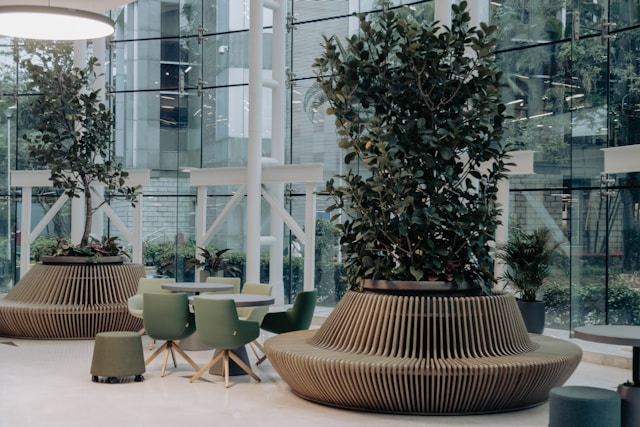
For years, “bringing the outdoors in” meant buying a few succulents and hoping they’d survive the winter. But as we move through 2026, biophilic interior design has evolved from a simple aesthetic trend into a vital wellness necessity. At SereneSpacesNSmiles.com, we believe your home should be a restorative ecosystem, not just a place to store your belongings.
If you’re ready to move past the plastic nursery pot, here is how to master full-sensory biophilic interior design to boost your mood, health, and home’s serenity.
What is Biophilic Interior Design?
Biophilic design is the practice of incorporating nature into our built environments to satisfy our innate human need to connect with the natural world. In 2026, the trend is moving away from “potted plants as decor” toward integrated natural systems that engage all five senses.
1. Sight: Living Architecture and Indoor Moss Walls
In 2026, greenery isn’t just sitting on the furniture—it is the furniture. To achieve a high-end biophilic look, look toward verticality and structural integration.
- The Power of Indoor Moss Walls: Unlike high-maintenance vertical gardens, preserved moss walls require no water or sunlight. They act as “living art,” providing a deep, textured green that lowers heart rates and even offers acoustic insulation for a quieter, more serene home.
- Visual Fractals: Nature is composed of “fractals”—patterns that repeat at different scales. By choosing rugs, wallpapers, or privacy screens with fractal patterns, you can reduce stress levels by up to 60%. This is the cornerstone of science-backed biophilic interior design.
2. Sound: The Rise of “Hydrological Zen”
True biophilia isn’t just seen; it’s heard. Most modern homes are filled with “gray noise”—the hum of the refrigerator or the buzz of the street. A biophilic home replaces this with “green noise.”
- Integrated Water Features: Moving water creates negative ions, which are known to improve mood and air quality. Modern water walls in 2026 are designed for laminar flow, meaning they provide a gentle, rhythmic sound without the messy splashing of older models.
- Acoustic Ecology: Consider hidden “soundscapes” that play high-fidelity recordings of wind through pines or distant rain, creating a background texture that masks urban stress.
3. Light: Circadian Lighting Benefits
Perhaps the most transformative element of biophilic interior design in 2026 is circadian-syncing lighting. Humans evolved to follow the sun’s cycle, yet we spend 90% of our time under static artificial lights.
A biophilic home uses smart bulbs to mimic the sun’s progression:
- Morning: Cool, blue-toned light to jumpstart your focus.
- Evening: Warm, amber hues that sit low in the room to trigger melatonin production. By syncing your lighting with your biology, you’re not just decorating—you’re optimizing your sleep and energy levels.
4. Touch: Tactile Authenticity
If every surface in your home is smooth, cold, or synthetic, your brain feels “sensory-deprived.” A primary goal of biophilic design is to introduce tactile diversity.
- Raw Materials: Swap out laminate for live-edge wood, unpolished stone, or cork. These materials hold temperature differently, providing a subtle “sensory map” as you move through your home.
- Natural Fabrics: Use linen, wool, and jute. These organic fibers provide a physical “grounding” sensation that synthetic polyesters simply cannot replicate.
5. Scent: The “Forest Bathing” Effect
The final layer of a 2026 biophilic home is the invisible one. Instead of synthetic “ocean breeze” sprays, use phytoncides—the natural compounds emitted by trees that are proven to boost the human immune system.
- The Scent of Serenity: Incorporating cedar, hinoki, or sandalwood through natural diffusers or raw wood elements can actually lower blood pressure.
- Bio-filtration: Use “active” plant walls that pump air through the roots of the plants, scrubbing the air of toxins and leaving a crisp, natural scent.
Why Biophilic Design Matters in 2026
We are living in an increasingly digital world. A home designed with biophilic principles acts as a “reboot” for your nervous system. By focusing on sight, sound, light, touch, and scent, you create a space that doesn’t just look like a magazine—it feels like a sanctuary.
At SereneSpacesNSmiles.com, we know that when your space is in harmony with nature, a smile is never far behind.