
Struggling with EMIs? Compare Debt Snowball vs Debt Avalanche to clear personal loans and credit cards fast in India. Boost your CIBIL score today.
Managing multiple debt obligations—from high-interest credit card roll-overs to instant fintech personal loans—can quickly become overwhelming. According to the Reserve Bank of India’s (RBI) Financial Stability Report, non-housing retail loans (including personal loans, credit cards, and consumer durable financing) account for 58.4% of total household debt in India, pushing overall household debt to 45.5% of GDP.
If you are trapped in a cycle of paying heavy Equated Monthly Installments (EMIs), choosing a structured strategy is essential to regain control of your finances.
Two battle-tested frameworks dominate personal finance: the Debt Snowball and the Debt Avalanche methods. Understanding how both work in the Indian financial landscape—and picking the right one—can accelerate your journey toward becoming debt-free and improving your credit profile.
What is the Debt Snowball Method?
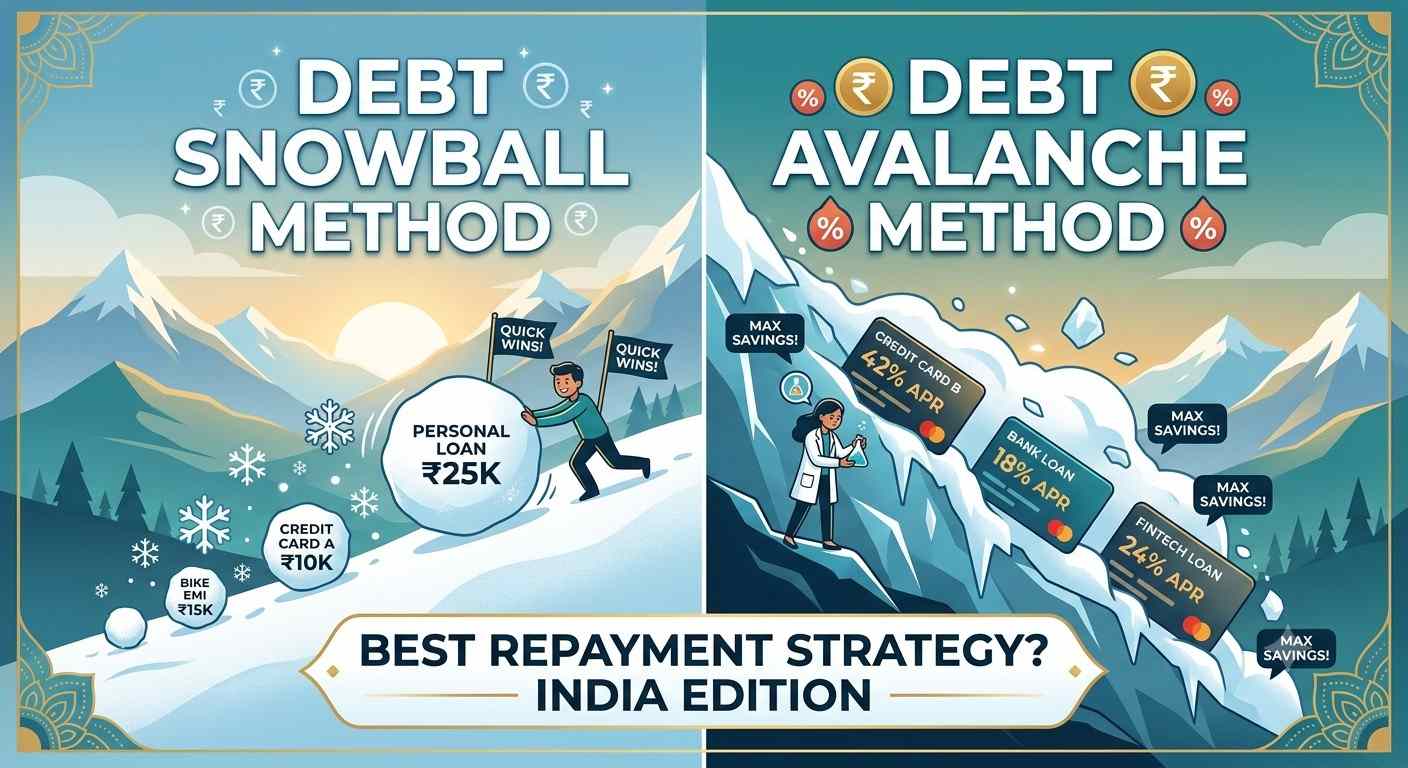
The Debt Snowball method prioritizes debts based purely on the outstanding loan balance, regardless of the interest rate charged by lenders.
How It Works:
- List all your outstanding debts (credit cards, Buy Now Pay Later accounts, personal loans) from the smallest balance to the largest balance.
- Pay the minimum required EMI or payment on all accounts every month.
- Channel every additional rupee from your budget toward paying off the smallest debt first.
- Once the smallest balance reaches zero, roll over the entire monthly amount previously allocated to it (its minimum EMI + extra payment) into targeting the next smallest debt.
Why It Works:
The Debt Snowball relies on behavioural psychology. Clearing small debts fast provides immediate psychological “wins.” These quick victories build momentum, keeping you motivated to handle larger obligations over time.
What is the Debt Avalanche Method?
The Debt Avalanche method prioritizes debts strictly by their Annual Percentage Rate (APR) or interest rate, targeting the most expensive loans first.
How It Works:
- List all your outstanding debts from the highest interest rate to the lowest interest rate.
- Pay the minimum EMI or payment on all accounts.
- Direct all remaining extra funds toward the debt carrying the highest interest rate.
- After eliminating the highest-APR debt, roll over the combined monthly paydown budget into the account with the next-highest rate.
Why It Works:
The Debt Avalanche is mathematically optimal. By eliminating high-interest debt first—such as credit cards charging 36% to 42% per annum—you minimize total interest accumulation and reduce your overall time spent in debt.
Comparison: Debt Snowball vs Debt Avalanche India
To compare both strategies, consider a typical debt portfolio for an Indian urban professional with a total monthly debt paydown budget of ₹25,000 (where required minimum EMIs total ₹15,000, leaving ₹10,000 extra):
- Debt A (Fintech Instant Loan): ₹20,000 balance | 18% APR | Min EMI: ₹2,000
- Debt B (Credit Card Revolving Balance): ₹60,000 balance | 40% APR | Min Payment: ₹3,000
- Debt C (Bank Personal Loan): ₹1,500,000 balance | 13% APR | Min EMI: ₹10,000
| Feature | Debt Snowball Method | Debt Avalanche Method |
| Payoff Order | Debt A → Debt B → Debt C | Debt B → Debt A → Debt C |
| First Target | Fintech Loan (Smallest Balance: ₹20k) | Credit Card (Highest APR: 40%) |
| Primary Advantage | Eliminates 1 account in Month 2 (Quick psychological win) | Saves maximum interest by stopping 40% APR compound growth |
| Best Suited For | Borrowers needing early wins to stay disciplined | Analytical mindsets focused on saving money |
Real-World Impact on Your CIBIL Score
Both debt paydown methods positively impact your CIBIL score, but through different mechanisms:
- Credit Utilization Ratio (CUR): Revolving credit card debt heavily drives CUR. Using the Avalanche method to clear high-interest credit card debt rapidly drops your overall CUR below the recommended 30% threshold, which can boost your credit score.
- On-Time Payment History: Payment history accounts for roughly 35% of your CIBIL score calculation. Both strategies mandate paying at least the minimum EMI on every account, keeping your payment track record clean.
- Debt Consolidation & Account Clearance: The Snowball method completely closes smaller loan accounts earlier. Having fewer active open loan accounts improves your overall credit profile.
If you suspect incorrect reporting or missed entries are holding down your score, read our detailed guide on 5 proven steps to remove errors from your credit report to clean up your credit history while executing your paydown strategy.
Key Factors When Managing Indian Loans
When applying these strategies to debt from Indian banks and NBFCs, keep these local factors in mind:
1. Credit Card Revolving Rates vs. EMI Conversion
Carrying a rolling credit card balance in India incurs heavy charges (3%–3.5% monthly, equivalent to 36%–42% p.a.) plus 18% GST on interest charges. Converting outstanding balances into flexible 6- to 12-month EMIs can drop interest rates down to 14%–18% p.a., making the repayment schedule more manageable.
2. Foreclosure Charges & RBI Regulations
Under RBI regulations, lenders cannot charge foreclosure or prepayment penalties on floating-rate individual loans. However, fixed-rate personal loans and NBFC loans may carry prepayment penalties ranging between 2% to 5% plus GST. Factor these fees into your calculations when accelerating repayments on personal loans.
3. Impact on Home Loan Eligibility
Clearing unsecured debts improves your Debt-to-Income (DTI) ratio. Indian home loan lenders prefer a total DTI below 40%–50%. If you plan to apply for a mortgage, check out our guide on what is a good debt-to-income ratio for buying a house to prepare your financial profile for homeownership.
Which Strategy Should You Choose?
- Choose the Debt Snowball if: You feel overwhelmed by multiple open loan accounts, need quick visual progress to build momentum, or struggle to stay consistent with long-term financial plans.
- Choose the Debt Avalanche if: You have substantial credit card debt (36%+ APR), want to minimize total interest costs, and are comfortable staying disciplined even if closing your first account takes several months.
Regardless of the method you select, combining a disciplined strategy with solid credit management techniques—as covered in our pillar guide on how to get out of debt and raise your credit score—will help you achieve long-term financial freedom.