
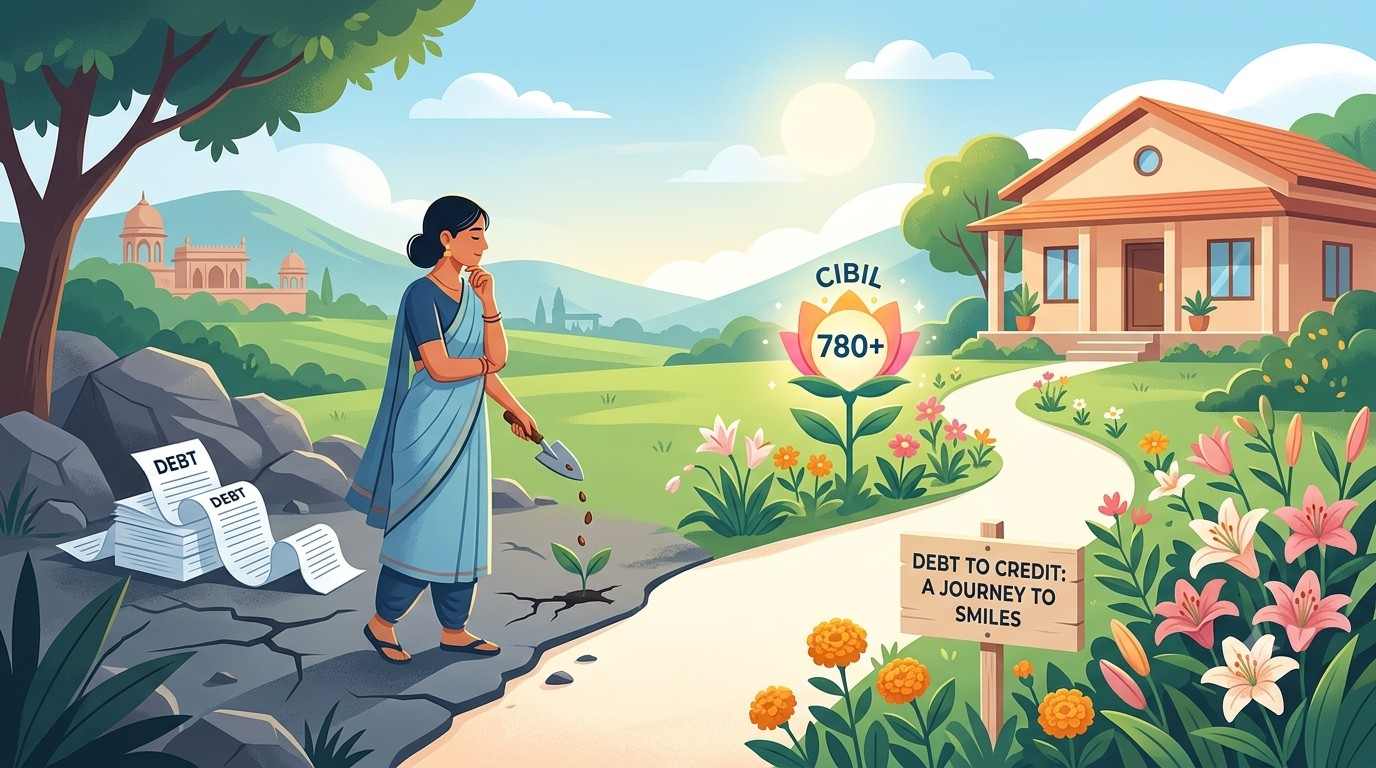
Managing personal finances in today’s fast-paced economy can feel overwhelming. With easy access to instant personal loans, credit card EMI conversions, and Buy-Now-Pay-Later (BNPL) schemes, debt can quietly accumulate. If you find yourself struggling with multiple loan repayments, asking how to get out of debt and raise your credit score is the first vital step toward financial freedom. At Serene Spaces & Smiles, we believe a peaceful life begins with a calm, debt-free financial foundation.
Key Regulatory Update (RBI Reporting Mandates): Under the Reserve Bank of India’s (RBI) Credit Information Reporting Directions, banks and NBFCs in India report borrower credit data to all four bureaus (CIBIL, Experian, Equifax, CRIF High Mark) four times a month (on the 9th, 16th, 23rd, and last day of the month). According to the RBI's Financial Stability Report, non-housing retail loans now account for over 58% of household borrowings in India. This faster reporting frequency means your credit discipline—or missed payments—impacts your score within days, making timely debt management more critical than ever.
Whether you want to clear credit card bills or optimize your debt-to-income ratio for buying house properties in India, here are a few ways and a step-by-step roadmap to financial wellness.
Different ways to get out of debt and raise your credit score
1. Choosing Your Payoff Strategy: Debt Snowball vs. Debt Avalanche
When tackling multiple loans or card balances, making random, uncoordinated payments leads to burnout. Adopting a structured payoff strategy is essential. The two most effective, globally proven frameworks are Debt Snowball vs. Debt Avalanche.
| Feature / Strategy | Debt Snowball Method | Debt Avalanche Method |
| Primary Focus | Lowest Principal Balance First | Highest Interest Rate (APR) First |
| Core Benefit | Quick psychological wins & momentum | Maximum savings on total interest paid |
| Best Suited For | Borrowers who need motivation to stay on track | Disciplined borrowers focused on math efficiency |
Method A: The Debt Snowball Method
The Debt Snowball prioritizes psychological momentum:
- List all your debts (credit card balances, personal loans, consumer durable EMIs) from the smallest balance to the largest balance, regardless of interest rate.
- Pay the minimum required EMI/payment on every debt every month.
- Put every extra rupee of surplus monthly cash flow toward clearing the smallest debt first.
- Once the smallest balance reaches zero, roll over the entire amount you were paying into paying off the next smallest debt.
Why it works: Eliminating small balances quickly gives you emotional wins, keeping you motivated to tackle larger debts over time.
Method B: The Debt Avalanche Method
The Debt Avalanche focuses purely on mathematical efficiency:
- Rank your debts from the highest interest rate (APR) to the lowest interest rate. (For instance, credit card debt charging 36–42% p.a. goes to the top, followed by personal loans at 14–18%, and gold loans at 10–12%).
- Pay minimum EMIs on all obligations.
- Direct all extra savings toward aggressively paying off the highest-interest debt first.
Why it works: By eliminating expensive debt first, you drastically reduce total interest payouts, saving thousands of rupees over your debt-free journey.
2. How to Remove Errors from Credit Report under RBI Rules
Paying off debt is only half the battle; ensuring your credit report accurately reflects your progress is equally important. In India, credit bureaus maintain your profile, but clerical mistakes, incorrect “Days Past Due” (DPD) entries, or fraudulent enquiries can drag down your score. Learning how to remove errors from credit report files is essential for reaching an 800+ CIBIL score.
Did You Know? Under RBI guidelines, every Indian citizen is entitled to one free comprehensive credit report per year from each of the four credit bureaus (TransUnion CIBIL, Experian, Equifax, and CRIF High Mark).
Step-by-Step Guide to Fixing Bureau Disputes:
- Fetch Your Official Reports: Download your free annual credit reports directly from official bureau portals rather than third-party tracking apps.
- Audit Account Details: Thoroughly check:
- Incorrect repayment status on accounts you paid on time.
- Accounts marked as “Written Off” or “Settled” when they were actually paid in full.
- Unrecognized loans or hard enquiries caused by identity theft or PAN misallocation.
- Raise an Online Dispute: Log in to the CIBIL Dispute Resolution Portal or Experian’s online platform. Select the erroneous entry, attach supporting proof (such as a bank NOC or payment receipt), and submit your dispute.
- Leverage the 30-Day RBI Mandate: RBI rules require banks and credit bureaus to resolve credit report disputes within 30 days. If a lender fails to correct an erroneous update within 30 days of notification, they are required to compensate the borrower ₹100 for every day of delay.
Also read How to Use the 50/30/20 Budget Rule for Financial Success that can help you keep your finances on track.
3. Optimizing Your Debt to Income Ratio for Buying House Properties
Owning a home is a major milestone for Indian families. However, before approving a home loan, banks evaluate your repayment capacity using your debt to income ratio for buying house eligibility (known in India as the Fixed Obligation to Income Ratio, or FOIR).
Calculating Your DTI / FOIR Ratio
Your Debt-to-Income ratio represents the percentage of your gross monthly income spent on existing monthly debt payments:
$$\text{DTI Ratio (\%)} = \left( \frac{\text{Total Monthly Debt Obligations}}{\text{Gross Monthly Income}} \right) \times 100$$
What DTI Ratios Do Indian Banks Expect?
- Ideal DTI (Below 30–35%): Banks view you as a low-risk borrower. You qualify for competitive interest rates, maximum tenure, and fast approvals.
- Acceptable DTI (36–45%): Most commercial banks (SBI, HDFC Bank, ICICI Bank) will approve your home loan if your CIBIL score is 750 or higher.
- High Risk (Above 50%): Lenders may reject the application or ask for a co-applicant (e.g., a working spouse), a larger down payment, or higher interest rates.
Pro Tip: Use the Debt Snowball or Debt Avalanche strategy to reduce your existing obligations below 30% before applying for a home loan. This leaves plenty of headroom for your new home loan EMI.
4. Daily Habits to Maintain a High Credit Score
Once your debts are under control and errors are fixed, adopt these habits to keep your credit score high:
- Maintain a Credit Utilization Ratio (CUR) Below 30%: Avoid maxing out credit cards. If your combined card limit is ₹2,00,000, keep total usage under ₹60,000 across billing cycles.
- Automate EMI Payments: Set up NACH or auto-debit mandates. Even a single delayed payment will be reported to bureaus quickly under the new weekly reporting cycle.
- Avoid Loan “Settlements”: Settling a loan for a lower payout leaves a “Settled” tag on your credit report for up to 7 years. Always negotiate a full principal payoff to receive a clean No Objection Certificate (NOC).
- Maintain a Healthy Credit Mix: Keep a balanced combination of secured loans (home/car loans) and unsecured loans (credit cards) over time.
Conclusion & Final Takeaway
Getting out of debt and building strong credit requires consistency, structured planning, and attention to detail. By selecting between the Debt Snowball vs. Debt Avalanche method, knowing how to remove errors from credit report records, and controlling your debt to income ratio for buying house applications, you can achieve financial freedom and build a serene, secure future.
For more practical guides on mindful living, home optimization, and personal wellness, subscribe to serenespacesnsmiles.com newsletter!