
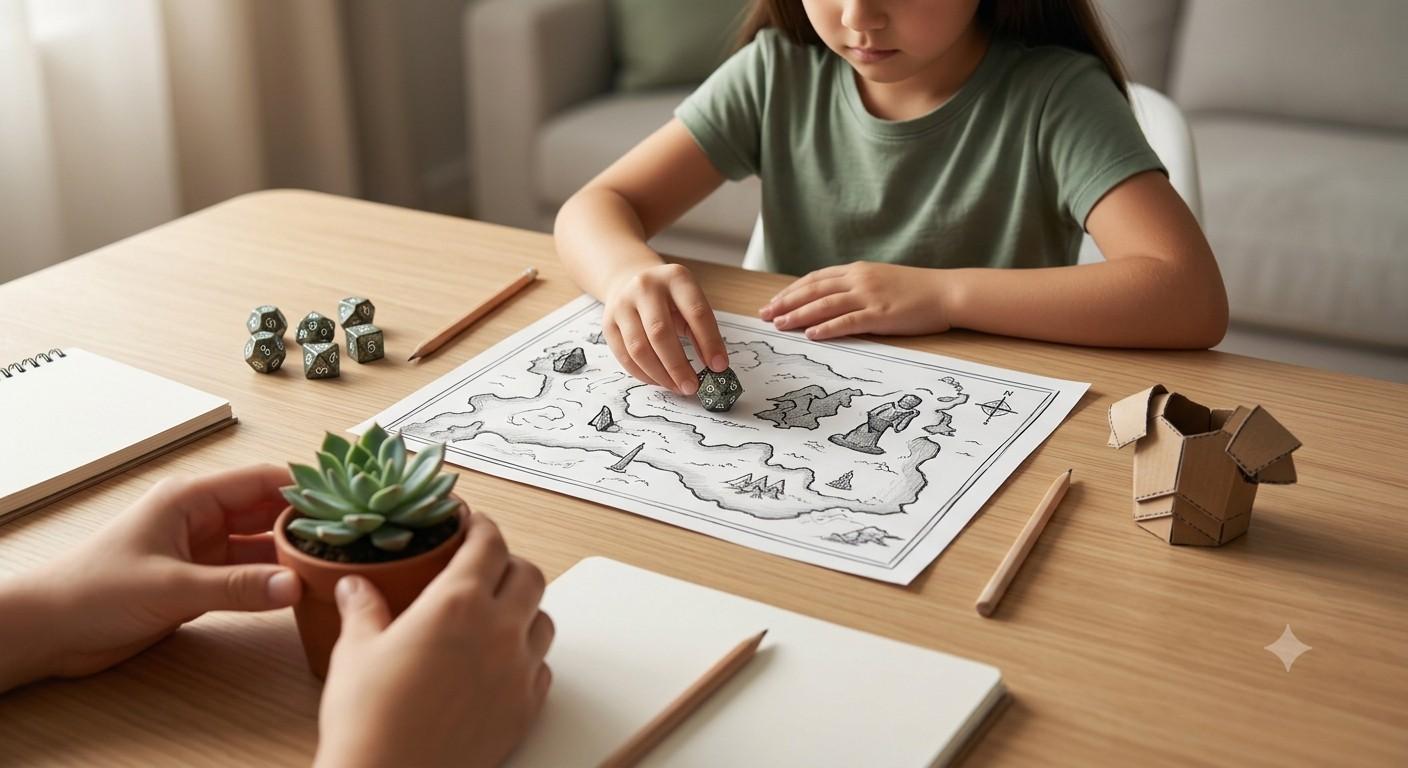
Every parent knows the scene: you announce it’s time to power down the console, and you’re immediately met with heavy sighs, slumped shoulders, and the inevitable line, “But I’m bored!”
It’s easy to see why. Video games are masterfully engineered to captivate young minds. They deliver immediate feedback, leveling-up rewards, high agency, and immersive worlds. Telling a child to “just go play outside” or “read a book” often falls flat because those suggestions don’t match the dynamic feedback loop their brains are chasing.
To pull kids away from the controller without a meltdown, we don’t need to banish excitement; we just need to match it. The secret lies in offering screen-free activities for kids that tap into the exact same psychological hooks: mastery, progression, world-building, and social play.
Below are 10 high-engagement, offline activities for kids instead of video games that offer real-world “level-ups” and can hold their ground against any video game.
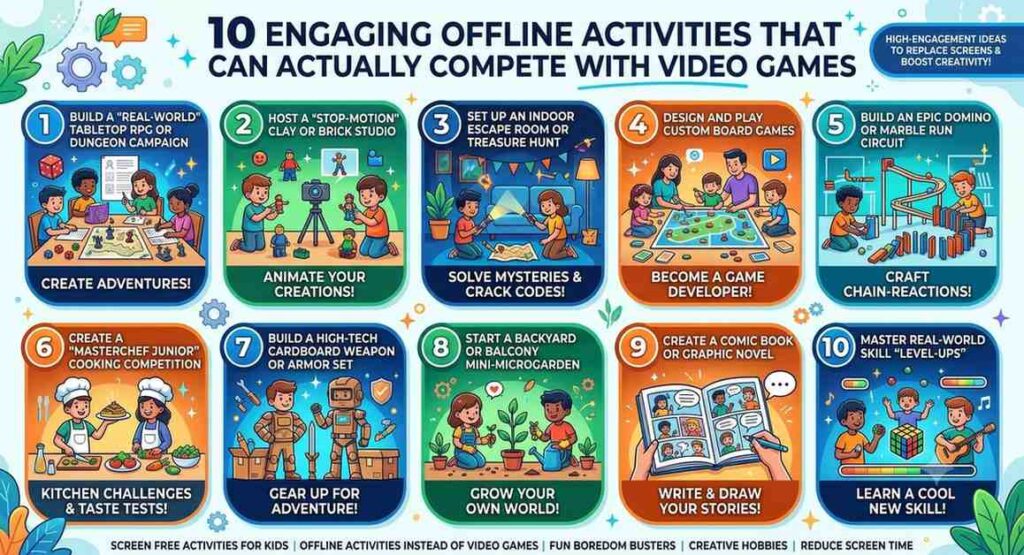
Top Offline Activities for Kids to Boost Engagement
1. Build a “Real-World” Tabletop RPG or Dungeon Campaign
If your child loves role-playing video games (RPGs) like Minecraft, Roblox, or Pokémon, bring that world onto the living room table. You don’t need complex rulebooks, just a piece of paper, a couple of six-sided dice, and their imagination.
Let them draw a map, create a character, and make decisions as you narrate a scenario: “You approach a locked door in a dark castle. Do you pick the lock or try to break it down?” Rolling dice to determine success brings the exact same thrill of chance and strategy as pressing buttons on a controller.
2. Host a “Stop-Motion” Clay or Brick Studio
Instead of spending hours playing building games, turn that spatial creativity into tangible art. Using modeling clay, magnetic tiles, or construction bricks, kids can build elaborate set pieces.
Take it a step further by introducing them to basic stop-motion principles using physical flipbooks or physical character poses. Crafting character arcs and physical scenes transforms passive screen consumption into active hands-on design.
3. Set Up an Indoor Escape Room or Treasure Hunt
Video games keep players hooked using objective-based progression: Find the key, unlock the door, clear the level. You can recreate this high-stakes feeling right at home.
Transform your hallway or living room into an escape room. Hide clues under couch cushions, write secret messages in lemon juice (revealed under a warm bulb), or set up a taped-grid “laser maze” across the corridor. Searching for hidden codes makes for incredibly fun boredom busters for children on rainy afternoons.
4. Design and Play Custom Board Games
Rather than playing a pre-made game, challenge your kids to become game developers. Grab a blank poster board, index cards, and tokens from old games.
Have them brainstorm:
- What is the goal of the game?
- What are the rules and penalties? (e.g., “Draw a card: go back 2 spaces” or “Boss Battle”).
- How do players win?
Designing board games channels creative hobbies to reduce screen time, shifting your child’s perspective from a gamer to an author of fun.
5. Build an EPIC Domino or Marble Run Circuit
The instant visual feedback of a chain-reaction circuit matches the fast-paced gratification of arcade-style video games.
Using wooden tracks, cardboard tubes, dominoes, and marbles, challenge your child to build a circuit that spans across multiple rooms or off furniture. The trial-and-error process inherently teaches engineering, patience, and physics—all while keeping their hands fully occupied.
6. Create a “MasterChef Junior” Cooking Competition
Cooking offers immediate, delicious rewards. Turn kitchen prep into a gamified challenge where kids get a mystery basket of 3 random ingredients (like an apple, pretzel sticks, and peanut butter) and must construct a snack signature dish.
Not only is this one of the most engaging indoor activities for kids, but it also teaches valuable life skills, sensory exploration, and mathematical measurement without feeling like schoolwork.
7. Build a High-Tech Cardboard Weapon or Armor Set
For kids who love action or adventure games, physical costume building provides a deep creative outlet. Give them a stack of delivery boxes, painter’s tape, safety scissors, and markers.
Challenge them to construct:
- A knight’s shield and sword
- Futuristic superhero armor
- A wearable robot helmet
Once completed, they aren’t just holding cardboard—they’ve crafted an entrance ticket into hours of imaginative roleplay.
8. Start a Backyard or Balcony Mini-Microgarden
Video games like Animal Crossing or Stardew Valley are wildly popular because kids love watching things grow under their care. Real-world gardening taps into that exact same sense of long-term investment.
Give your child their own pot or small garden patch. Quick-germinating seeds like radishes, basil, sunflowers, or beans provide quick visual progress within days. Checking on their plants daily builds a healthy routine that anchors them in the physical world.
9. Create a Comic Book or Graphic Novel
If your child loves story-rich games, prompt them to translate those ideas onto paper. You can print free blank comic strip templates online or fold printer paper into a mini-booklet.
Developing characters, drawing action sequences, and writing dialogue exercises both sides of the brain. By the end of the day, they won’t just have spent time off screens—they’ll have a finished comic book to show off proudly to family and friends.
10. Master Real-World Skill “Level-Ups”
Kids love video games because they get to watch their skill meters fill up. Replicate this visually in the real world with a Skill Progression Chart.
Pick a physical skill your child wants to master:
- Learning to juggle 3 balls
- Solving a Rubik’s cube
- Learning 5 magic tricks
- Mastering a specific song on the ukulele or keyboard
Create a simple visual tracker on the fridge. Every day they practice, they earn “XP” (experience points) or stickers toward a reward. Reaching “Level 5” in a real-world skill builds genuine confidence that no virtual achievement badge can replicate.
Bridging the Gap: Making the Transition Smooth
Replacing video games isn’t about removing fun; it’s about shifting where that fun comes from. When introducing these screen free activities for kids, remember to participate initially. Once the momentum of an offline activity takes over, you’ll find your kids reaching for paint, cardboard, and dice just as naturally as they used to reach for the controller.